Nearly $1.7 billion in restitution, forfeiture, and fines has been erased by presidential clemency since January 2025, according to House Judiciary Committee Democrats. That money will not be collected. The people who owed it are free.
This is the story of how that happened, according to a Reuters investigation, a congressional staff report, and the government’s own list of who got clemency and when.
The Numbers Behind the Pattern
On June 11, 2026, Reuters published an investigation (discussed in this NPR segment) comparing Trump’s second-term clemency grants to the Justice Department’s own longstanding guidelines for who qualifies for a pardon or commutation.
The investigation found that 96% of those grants failed to meet those guidelines. In Trump’s first term, about 14% failed to meet them. Under President Biden, it was under 1%.
Since January 2025, Trump has granted clemency to a large number of people, including a blanket pardon for those convicted of offenses tied to January 6, 2021. The Justice Department’s Office of the Pardon Attorney keeps the official record of each grant.
Reuters also identified 290 people it called “influencers” — individuals who lobbied on behalf of clemency applicants. Those 290 people lobbied 624 times across 197 successful second-term clemency cases. At least 110 of them were already known Trump allies. Eleven had themselves previously received clemency from Trump before going on to lobby for someone else’s release.
‘Pardons, Inc.’
On August 21, 2026, House Judiciary Committee Democratic staff released a report titled “Pardons, Inc.” The committee’s Democrats estimated that nearly $1.7 billion in restitution, forfeiture, and fines was erased through second-term clemency grants.
The same report noted that about 14,000 clemency applications were still pending at the Justice Department at the time — filed through the normal process, waiting in line.
Who Got Clemency
The report and the Reuters investigation cite specific cases.
Juan Orlando Hernández, the former president of Honduras, was serving a 45-year sentence for cocaine trafficking. He appears on the Justice Department’s official list, which records a pardon granted on December 1, 2025 of people granted clemency in the second Trump administration.
Joseph Schwartz, a nursing-home operator, was convicted in a $38 million payroll-tax fraud case. According to the Judiciary Committee report, Schwartz spent nearly $1.1 million lobbying for his own release while serving his sentence.
Timothy Leiweke was facing a federal bid-rigging prosecution when he received a pardon, which ended the case. The Judiciary Democrats’ report highlights his case among its examples.
These three cases are presented in the sourced reports as examples of the broader pattern Reuters and House Judiciary staff documented. They are not, on their own, proof of a direct quid pro quo in any individual case — that determination has not been made by a court.
The Pardon Czar
The White House has an official in charge of managing this process: Alice Marie Johnson, described in reporting as the administration’s “pardon czar.” In September 2026, Johnson announced another 30 people had been granted clemency.
A Congressional Inquiry, Not an Indictment
In May 2026, Representatives Dave Min and Raul Ruiz, along with Senator Peter Welch, opened a formal congressional inquiry into the alleged pay-to-play clemency scheme. They sent letters to 17 pardon and commutation recipients asking them to explain how they obtained clemency.
That inquiry remains open. It has not resulted in charges. The presidential pardon power carries almost no legal checks, and no official is required to explain any individual grant.
Two Tracks
Here is where the reporting ends and interpretation begins: the numbers describe what looks like a two-track system. One track runs through the Justice Department’s normal clemency process, where roughly 14,000 applicants are still waiting. The other track appears to run through lobbyists, campaign donations, and personal access to people already inside the administration.
The Constitution frames the pardon power as an act of mercy — for people who are reformed, or who were wrongly convicted. Reuters’ 96% figure, the Judiciary Democrats’ nearly $1.7 billion estimate, and the specific cases cited above are the documented record. What conclusion you draw from that record is up to you.
Read the source documents yourself: NPR’s discussion of the Reuters investigation, the Judiciary Committee report, and the Justice Department’s list of clemency grants.
Visit themoraldecayindex.com and tell us your verdict: is this mercy, or is this a market?
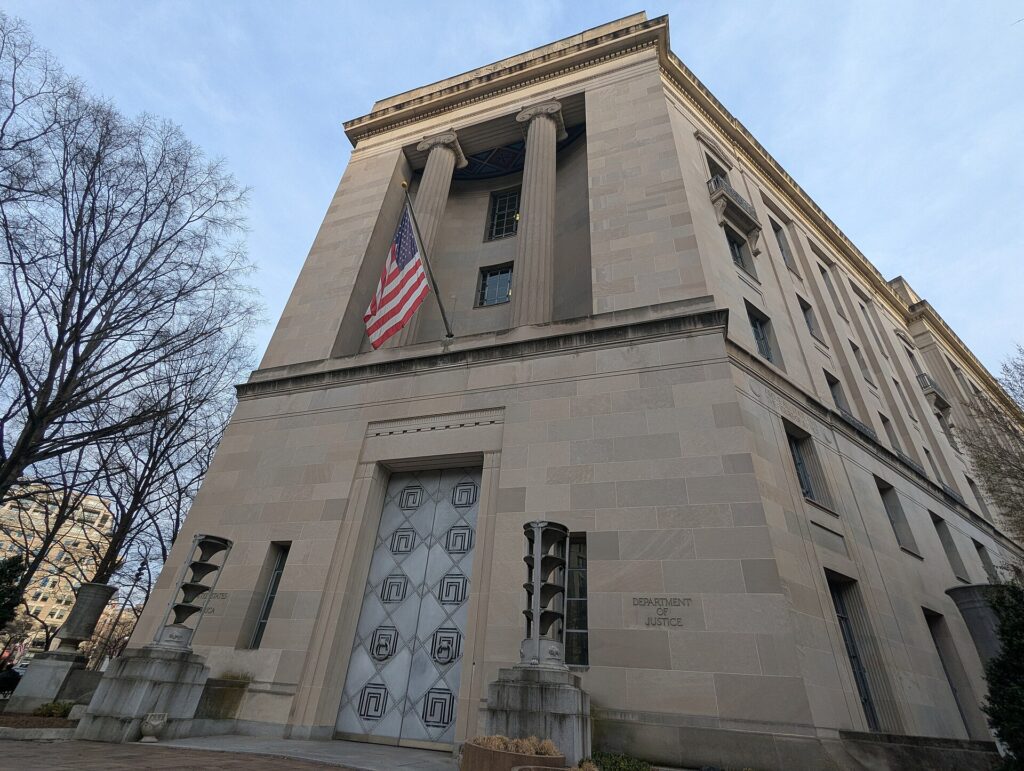
Photo: Robert F. Kennedy Department of Justice Building in Washington, D.C., by Sdkb, CC BY-SA 4.0, via Wikimedia Commons.