Michael J. Madigan spent decades as the most powerful man in Illinois state government. He was Speaker of the Illinois House longer than anyone in state history. That power, federal prosecutors said, came with a price tag — and courts have now agreed, twice.
In February 2025, a federal jury convicted Madigan on 10 counts, including bribery conspiracy and wire fraud, tied to a scheme involving the utility company Commonwealth Edison. U.S. District Judge John Blakey later sentenced him to 7.5 years in federal prison. Blakey also found that Madigan lied to the jury when he took the stand in his own defense. Madigan reported to a minimum-security federal prison camp in Morgantown, West Virginia, in October 2025.
On April 27, 2026, a three-judge panel of the 7th U.S. Circuit Court of Appeals unanimously upheld that conviction. The judges wrote that trial evidence exposed a concealed arrangement to trade Madigan’s enormous political influence within the Illinois General Assembly for more than $3 million in benefits funneled to his political allies, according to the Chicago Sun-Times.
Now Madigan is trying one more door. In late July 2026, his attorneys filed a petition asking the U.S. Supreme Court to take up the case, as the Sun-Times reported. The petition itself is dated July 27, 2026. The petition challenges how courts define acting “corruptly” and what legally counts as an “official act” under federal bribery law, a question also detailed by Madigan’s Supreme Court petition. The Supreme Court could announce whether it will hear the case as soon as October 2026.
The petition asks the justices to decide three questions. First, whether a public official acts “corruptly” simply by understanding that someone is trying to influence his official duties. Second, whether vague future legislation that could affect a company’s finances is specific enough to count as a “question or matter” under federal bribery law. Third, whether a legislator’s promise to recommend someone for a job to a governor-elect counts as an “official act.” Madigan’s lawyers argue the 7th Circuit’s standards conflict with other federal appeals courts and with Supreme Court precedent.
The appeals court saw the case very differently. In its April 27, 2026 ruling upholding all 10 guilty verdicts, the three-judge panel wrote that Madigan “repeatedly facilitated changes to state law impacting countless energy consumers in northern Illinois, all because ComEd funneled money to the right people.” He is serving a 7½-year federal prison sentence. Capitol News Illinois.
That is the real tension in this case, and it is bigger than one politician. The Supreme Court has been narrowing federal corruption law. In June 2024, in Snyder v. United States, it held that the main federal bribery statute for state and local officials does not criminalize gratuities paid after the fact. If the justices take this case, they will decide whether a powerful legislator who never signs a quid pro quo on paper can still be held to account for selling his influence. Every statehouse in America will be watching.
The Legitimacy Gap
Illinois voters sent Madigan to the statehouse to write laws in the public interest. That is the deal every elected official signs up for. Editorially, that’s the gap worth sitting with here: prosecutors and now a federal appeals court found that instead of serving that public interest, Madigan ran a hidden pay-to-play operation, trading his legislative power for no-show jobs, contracts, and favors funneled to a small circle of allies.
He was not an outsider gaming the system from a distance. He was the system, for decades. The 7th Circuit’s ruling did not just affirm a jury’s verdict — it affirmed the specific finding that Madigan’s influence was for sale, dressed up as ordinary politics.
What Happens Next
Madigan is currently serving his sentence at the Morgantown federal prison camp while his legal team pursues the last realistic avenue left: a Supreme Court that takes only a small fraction of the cases presented to it. If the justices decline to hear the case, the conviction and sentence stand as final. If they take it up, the legal questions about what counts as corrupt official conduct could ripple far beyond Illinois.
Either way, the appeals court’s April 2026 ruling stands as the most detailed judicial affirmation yet that the state’s longest-serving legislative leader operated a corruption scheme, not just a political career with rough edges.
What’s your verdict on this one? Head to themoraldecayindex.com and tell us where you land.
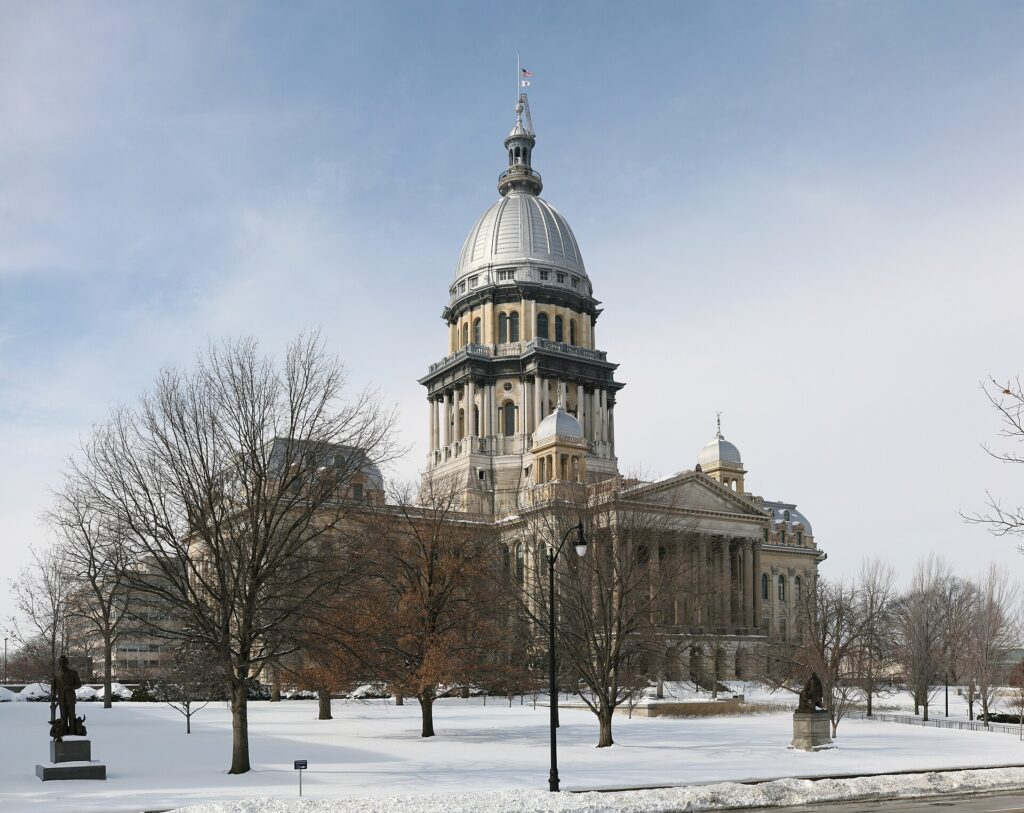
Photo: Illinois State Capitol in Springfield, by Daniel Schwen, CC BY-SA 4.0, via Wikimedia Commons.