
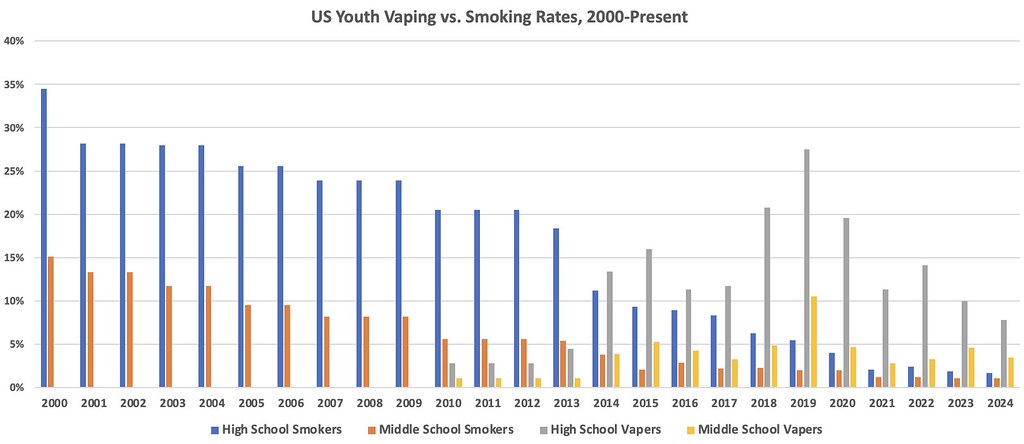
The CDC keeps announcing that youth vaping is falling. It is — and 1.13 million American high schoolers are still doing it, more heavily than ever, on nicotine pouches now too.
The Good News Is Doing a Lot of Work
Here is the headline version: 7.1% of U.S. high school students reported current e-cigarette use in the 2025 National Youth Tobacco Survey, down from a peak of 27.5% in 2019. Read as a press release, that is a public-health triumph — a two-thirds drop in six years, driven by flavor bans, FDA enforcement actions, and a wave of import alerts against disposable brands like Elf Bar. Read as anything more than a headline, it is a story about how a nicotine habit mutated to survive the crackdown rather than disappearing.
Start with what “current use” actually measures now. Among the students still vaping, daily use has climbed from 9.4% of users in 2014 to 35.4% in 2025. Fewer teenagers are picking up the habit casually; more of the ones who do pick it up are hooked hard enough to do it every single day before they can legally buy a lottery ticket. The industry didn’t lose a third of its teenage customers so much as it lost the casual ones and kept the addicts.
“Every year we get a press release that says vaping is declining, and every year the kid in third-period study hall still has one in his sock.”
The Pouch Is the New Vape
While regulators were busy chasing disposable e-cigarettes off shelves, nicotine pouches — the tobacco-free, spit-free pouches marketed under brands like Zyn — quietly became the second most-used tobacco product among high schoolers, at 5.2% current use in the 2025 survey. They’re tiny, odorless, easy to use in a classroom with a hand cupped over the mouth, and marketed through the same influencer-adjacent channels that made disposable vapes a status object a few years ago. Regulate one delivery mechanism hard enough and nicotine simply finds the next one; the industry has had two centuries of practice at this exact maneuver.
None of this is abstract to the kids living it. Nicotine reshapes the adolescent brain’s reward circuitry in ways that are still developing until the mid-twenties, and researchers have tied early nicotine exposure to measurably higher rates of later addiction to other substances. A generation raised to believe cigarettes were their grandparents’ problem has been quietly re-introduced to the same chemical, repackaged in a fruit-flavored aluminum tube that fits in a hoodie pocket.
What “Declining” Doesn’t Capture
Public health officials aren’t lying when they call this progress — the raw prevalence numbers really have fallen, and that matters. But a policy win measured only in headline prevalence misses the two things that matter most for the next decade: how dependent the remaining users are, and how many new products are queued up to replace the one just banned. A 25-year low in overall tobacco product use, which the CDC touted in 2024, sits next to a rise in daily intensity among the students who never quit. That’s not a resolved problem. That’s a problem that got better at hiding.
📊 Index Impact — Youth Vaping & Nicotine
7.1% (1.13M)
35.4%
5.2%
Mixed
⚠ Warning
The Index tracks vaping not because the topline number is scary this year, but because it’s a case study in how a decay indicator can look like it’s healing on the surface while the underlying dependency gets worse. A nation that keeps declaring victory over teen nicotine addiction, one product category at a time, is going to keep being surprised by the next one.
Stay informed. Get the monthly index update delivered to your inbox.