
The United States national debt has surpassed $36 trillion. Interest payments now exceed the entire defense budget. Every child born in America today arrives carrying a share of this obligation they never agreed to. The national debt is not merely an economic problem — it is a profound moral failure, representing one generation’s decision to consume resources that belong to the next.
Numbers That Should Be Unthinkable
The U.S. national debt reached $36 trillion in early 2026 — up from $10 trillion in 2008, $20 trillion in 2017, and $30 trillion in 2022. The acceleration is not slowing. The Congressional Budget Office projects that, under current policies, the debt will reach $50 trillion within a decade and will continue rising indefinitely as a share of GDP. There is no credible fiscal scenario, under current political conditions, in which the debt stabilizes or declines.
The annual interest cost on this debt now exceeds $1 trillion — more than the United States spends on national defense, more than Medicare, more than Medicaid. Interest payments produce nothing. They fund no roads, no schools, no military capability, no social services. They are the pure cost of past consumption paid by present taxpayers and borrowed against the future earnings of children not yet in the workforce.
The Moral Accounting
The economic debate about debt sustainability is real but secondary to the moral question. Every dollar of deficit spending represents a transaction in which the current generation of voters receives a benefit while a future generation — one that has no voice in the decision — is handed the bill. This is not a conservative or liberal argument. It is a basic principle of intergenerational justice: one generation does not have the moral right to obligate the next to pay for its consumption.
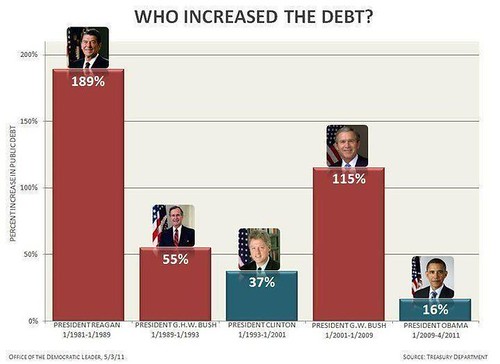
Both political parties bear responsibility for this trajectory. The debt grew substantially under both Republican and Democratic administrations, through tax cuts that were not offset by spending reductions and spending increases that were not funded by tax increases. The consistent pattern across administrations of both parties is that the political costs of fiscal discipline — telling voters they cannot have both lower taxes and higher spending — are avoided at the expense of future generations who cannot vote to protect themselves.
“Every generation since the 1980s has made essentially the same choice: to consume now and borrow against the future. The compounding of that choice has now produced an obligation so large that honest acknowledgment of it is itself politically dangerous. That is what moral failure looks like at civilizational scale.”
The Inflation Tax
When governments cannot or will not repay their debts directly, they often repay them through inflation — by printing money to service obligations, which reduces the real value of the debt while simultaneously reducing the purchasing power of every dollar held by ordinary citizens. The inflation surge of 2021–2023, which eroded wages and savings across the American middle class, was directly connected to the fiscal choices made during the COVID pandemic, when roughly $6 trillion in new spending was authorized in less than two years.
Inflation functions as a hidden tax, paid most heavily by those least equipped to absorb it — working-class families on fixed incomes, retirees on fixed pensions, and savers who played by the rules and deferred consumption. It is, in moral terms, a transfer from the fiscally prudent to those who borrowed and spent without restraint. That the political class bore none of this cost while the public bore all of it is a study in the corruption of democratic accountability.
What This Means for American Children
A child born in America in 2026 enters life with a debt obligation of roughly $107,000 — their share of the national debt — before they have taken a single breath. By the time they enter the workforce, that share will be substantially higher. They will spend their productive years paying interest on debts incurred for wars they did not choose, programs they did not vote for, and tax cuts that provided no benefit to them.
This is a moral relationship between generations, and the current generation has chosen badly. A society that truly valued its children would not leave them this inheritance. It would accept the short-term political pain of fiscal discipline as a moral obligation — the same moral obligation that leads responsible parents to sacrifice for their children rather than burdening them with debt.
📊 Index Impact — Fiscal Health Indicators
The Moral Decay Index Verdict
Fiscal irresponsibility is a moral issue, not merely a technocratic one. The national debt reflects a political culture that systematically prioritizes present consumption over future obligation, that refuses honest accounting to the electorate, and that treats the next generation as a resource to be exploited rather than a constituency to be served. By those standards — honesty, accountability, and intergenerational justice — the fiscal record of American governance over the past forty years registers as a serious and ongoing moral failure.
The Moral Decay Index will continue tracking fiscal indicators alongside social ones, because a society’s willingness to live within its means and keep faith with its children is as much a measure of its moral health as any other indicator in this dataset.
Stay informed. Get the monthly index update delivered to your inbox.
— David D.