
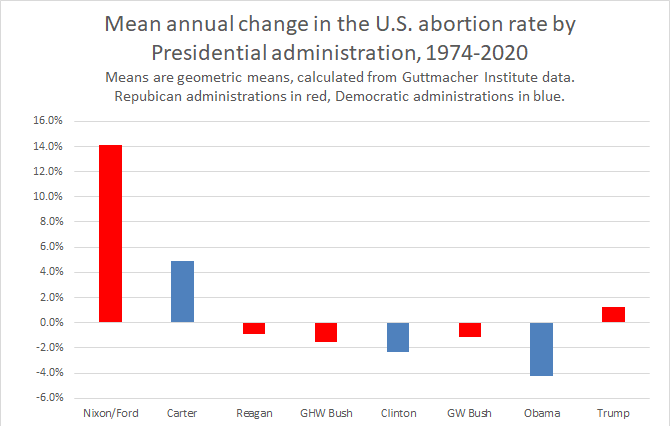
In 2025, approximately 1,126,000 abortions were performed in the United States — a number that has increased 16% since 2020 and represents the third consecutive annual increase since the Supreme Court’s Dobbs decision returned the question to the states. The abortion rate stands at 16.7 per 1,000 women of reproductive age. For the Moral Decay Index, abortion is tracked as a signal not of political preference but of a deeper question: what does a society’s relationship with its most vulnerable members reveal about its moral character?
The Numbers After Dobbs
When the Supreme Court overturned Roe v. Wade in June 2022, many observers expected a sharp decline in abortion numbers as state restrictions took effect. The data has told a more complicated story. While abortions fell sharply in states that enacted strict restrictions, the overall national number has continued to rise, driven by expanded telehealth provision across state lines, medication abortion via mail, and travel to states where abortion remains legal and accessible.
The Guttmacher Institute confirmed approximately 1,126,000 clinician-provided abortions in 2025, essentially unchanged from 2024’s 1,124,000 and up from an estimated 970,000 in 2020. The proportion of abortions provided via telehealth increased from 5% in mid-2022 to 27% by mid-2025. The method of provision has changed dramatically. The frequency has not declined — it has risen.
What the Index Measures and Why
The Moral Decay Index does not take a position on the legal status of abortion — that is a question for the democratic and judicial processes of a self-governing society. What this index tracks is the broader cultural and moral context in which abortion occurs at the rate of over one million per year: the conditions that produce unwanted pregnancies at scale, the social supports that are or are not available to pregnant women, the strength or weakness of the family and community structures that make parenthood possible, and what it reflects about a society’s relationship with new human life.
Each of those contextual factors — family breakdown, economic precarity, the collapse of support structures, the retreat of the institutions that historically supported both mothers and children — is documented elsewhere in this index. The abortion rate is not a cause of social decay. It is one consequence of multiple overlapping social failures that have made parenthood increasingly difficult, unsupported, and, for many, impossible to sustain.
“The question abortion forces upon us is not primarily a legal one — it is a moral one: what kind of society do we want to be, and what does our answer to that question cost, and who pays that cost? A society serious about reducing abortion must be serious about creating the conditions in which choosing life is genuinely possible for every woman who conceives.”
The Conditions That Drive the Numbers
Research on the reasons women seek abortions consistently identifies a cluster of overlapping factors: financial constraints, relationship instability, lack of partner support, housing insecurity, existing childcare burdens, and the sense that a child would be impossible to care for adequately given current circumstances. These are not primarily ideological reasons — they are the practical consequences of living in a society where the supports that once made family formation possible — affordable housing, stable employment, extended family networks, community support — have seriously eroded.
A society genuinely committed to the protection of unborn life must be simultaneously committed to the conditions that make choosing life a realistic possibility: accessible prenatal and postnatal care, affordable childcare, housing stability, living wages, and the kind of extended community and family support networks that have historically made the early years of parenting survivable. The debate about abortion that focuses exclusively on legal restrictions while ignoring those conditions is incomplete at best and morally incoherent at worst.
📊 Index Impact — Abortion Rate Indicator
Stay informed. Get the monthly index update delivered to your inbox.
— David D.